

The Cameroonian journalist and film critic is among the critics who came together to revisit the artistic legacy of Algerian filmmaker Mohammed Lakhdar-Hamina during the 5th edition of the Annaba Mediterranean Film Festival, held from September 24 to 30, 2025.
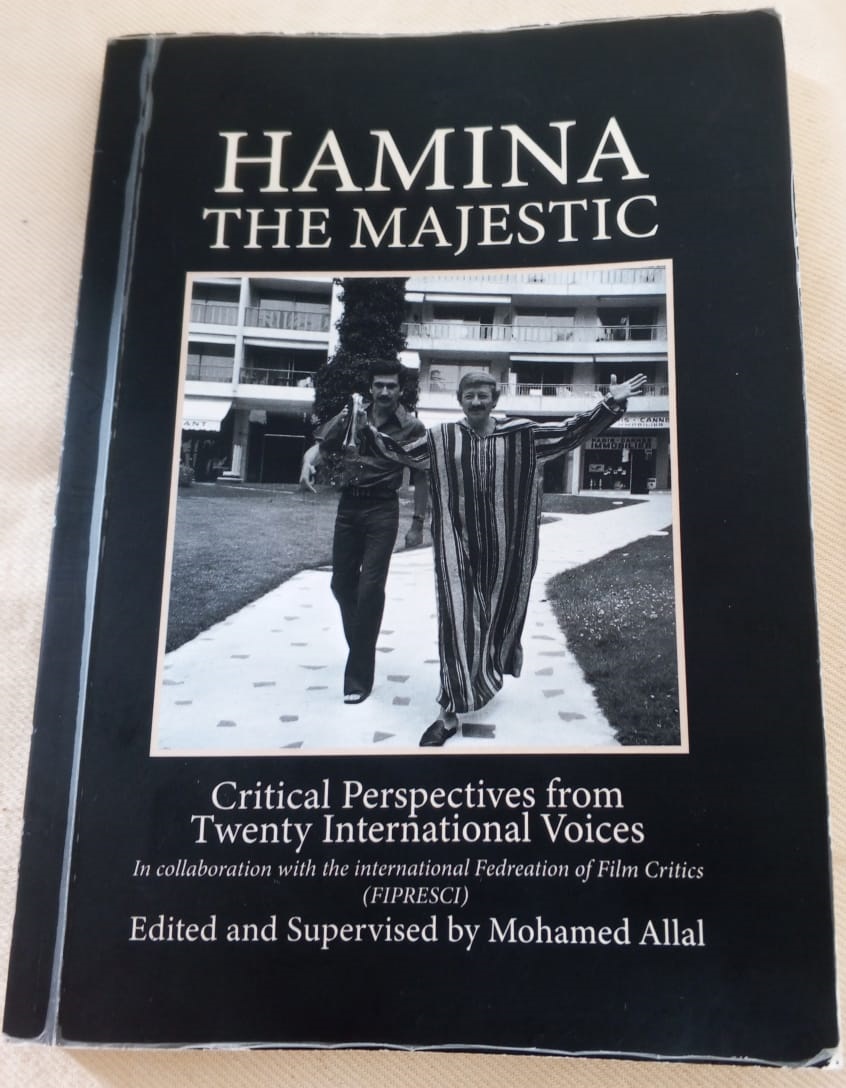
The president of the Cameroonian Association of Film Critics (Cinepress), Pélagie Ng’Onana, is among the 20 film critics from 17 countries who joined Mohamed Allal to create “Hamina the Majestic,” a collaborative work that, beyond paying tribute, presents the life of the renowned Algerian director Mohammed Lakhdar-Hamina, who passed away on May 23, 2025, at the age of 95.
An icon of Algerian cinema, director Mohammed Lakhdar-Hamina was the first African and Arab director to win the Palme d’Or at the Cannes Film Festival with the feature film “Chronicle of the Years of Embers” in 1975. To pay him a final tribute worthy of his stature, the Algerian film critic Mohamed Allal had the brilliant idea of bringing together renowned African critics who had, in one way or another, known the director.
Pélagie Ng'Onana's Contribution to the Memory of African Cinema
Alongside Pélagie Ng'Onana, this 190-page book, produced in collaboration with the International Federation of Film Critics (FIPRESCI) and written in English, features several well-known film critics, including Irian Peña Popo and José Rafael Rojas Bez (Cuba), Bijan Hassan Tehrani (Iran), Sofia Alvarez Salas (Peru), Mohamed Ghandour (Lebanon), Ahmed Al-Alyad (Saudi Arabia), Eva Pedro and Eduardo Guillot (Spain), Zein El Abidin Khairy and Omnia Adel Hassan (Egypt), Alexander Gabelia (Georgia), Aina Randrianatoandro (Madagascar), Roberto Baldassari (Italy), Salim Al Biek (Palestine), Dinu Ioan Nicola (Romania), Youssouf Haldo Harouna (Niger), and Steven Yates. (Great Britain) and João Antunes (Portugal).
For Pélagie Ng’Onana, this adventure was “an enriching and rewarding experience,” which she joined following a call for article submissions launched by Mohamed Allal. “It was a publishing project to pay tribute to the African filmmaker and celebrate the 50th anniversary of his triumph at the Cannes Film Festival. In this book, Mohamed Allal also wanted to celebrate his commitment to the art of film and to Algerian cinema,” she explains, revealing that the call for submissions, received by email, was sent to a number of renowned film critics from several continents.
“When I received the email, I thought I wouldn’t be able to participate because I didn’t really know him. But I found the initiative commendable,” she confides. For the Cameroonian journalist and critic, a former member of the executive committee of the African Federation of Film Critics (FACC), it is important to produce works that immortalize iconic African figures, whether for tribute, documentation, posterity, or other reasons.
Later, Pélagie Ng’Onana was persuaded and submitted a piece that was accepted. She offers an insightful article developed by gathering the opinions of Cameroonian filmmakers from different generations than that of filmmaker Mohammed Lakhdar-Hamina. She also consulted with Jean-Pierre Bekolo and Joseph Akama, who helped her progress with the writing. She says she thoroughly enjoyed the process: “I am proud to have represented Cameroon in this editorial project.” “I find it to be a rewarding publishing project because it is international and, therefore, will also reach an international audience,” she said.
The Exceptional Career of Mohammed Lakhdar-Hamina
Born in 1934, Mohammed Lakhdar-Hamina joined the FLN (National Liberation Front) in Tunis in 1958 after his father was tortured to death. Trained in Czechoslovakia, he participated in the struggle for independence through cinema, notably with Djamel Chanderli, through the films "Yasmina," "The Voice of the People," and "The Rifles of Freedom." His career is closely linked to the birth of Algerian cinema during the War of Independence.
After independence, he headed the Algerian Newsreel Office from 1963 to 1974, then the National Office of Cinema and the Film Industry (ONCIC) between 1981 and 1984. In 1965, he directed "The Wind of the Aurès," which won the Best First Feature Award at the Cannes Film Festival in 1967.
He continued his career with "Hassen Terro" (1968), "December" (1972), and especially "Chronicle of the Years of Embers" (1975), a monumental historical epic dedicated to the Algerian resistance against French colonization. The film won the Palme d'Or at Cannes, a first for African and Arab cinema. He then directed "Sand Wind" (1982), "The Last Image" (1985), and "Twilight of Shadows" (2014), his last feature film.
By Tatiana Kuessie




Comments
Log in to comment.
Log inNo comments yet. Start the conversation!